Next semester, I’m opening my critical theory class with the first 9 minutes of this BBC interview with Meredith Whittaker.
A small defense of the humanities, which apparently we still need in 2026.
9 minutes in and nobody has mentioned prompt engineering. And since I’ll probably be stopping the video every thirty seconds to say something, here’s what I’d say:
Last semester, I got this anonymous evaluation from a student: “It felt like we had more fun than we learned tangible things, but I am not complaining. Let her do things the way she finds them correct.”
I studied theater and linguistics. Now I work with AI. Which, if you think about it, still involves people constructing images of the world, mostly with words, and asking other people to believe them.
The idea that critical theory isn’t tangible enough is precisely why I still teach. And the big money, of course.
I’ve been teaching at universities for almost 15 years now, mostly in France but also in the Anglosphere, where I’ve sometimes been surprised by how rarely the idea that “if you’re not paying for something, you might be the product” even comes up.
A female student once told me she’d never experienced gender-based harassment. I said, well, good for you! But perhaps we could open that conversation up to the rest of the world.
And that’s the thing about information. Even when we consider ourselves terribly critical and analytical, we’re still working with whatever information we’ve been given and whatever we’ve had the means to access.
Which is why we need critical theory, not as a collection of opinions about the world, but as a set of methods for discovering what we don’t know, what we haven’t been shown, and why.
Interdisciplinarity and multilingualism are key to almost everything.
In The Future of an Illusion (1927), Freud (a man I don’t particularly cherish) describes civilization as something imposed on a resistant majority by a minority that holds the means of power. For my master’s thesis, I became interested in the possibility of a different kind of cultural toolkit, one that would give people access to more disciplines, more languages, and therefore more than one way of describing the same phenomenon.
Because once you’ve learned that something can have several definitions depending on where you are, what language you speak, or who you’re talking to, it becomes a little harder to believe that your own understanding is the only possible one.
There’s a connection between that and empathy, although knowing five languages obviously doesn’t prevent you from being an idiot. It just gives you five different ways of being one.
There’s always a whiteboard when somebody is about to solve the problems of people who aren’t in the room. I also know those three Mikes personally, along with their friends Danny and Rob.
If we actually gave the people we’re making decisions about access to the boardroom, we’d have to reconsider who gets to make the decisions in the first place. Which would change the distribution of power, and that’s already starting to sound suspiciously like democracy.
And democracy, as we know, is a terribly inefficient way to conduct a meeting, especially when you’ve already decided what everybody needs.
My students often ask if I went to a prestigious school, and I laugh. I also spend a considerable amount of time explaining why, when I was sent to university at fifteen, I chose theater of all things.
I grew up in an environment where studying was about understanding the world rather than necessarily succeeding in it, acquiring a profession, or becoming somebody with a very impressive job title.
In the process of learning what you want to learn, you also discover how you see the world and what you consider worthy of your attention. And perhaps that’s how you end up doing meaningful things, even if you haven’t necessarily acquired a very marketable set of skills.
And sometimes you become a theater student at fifteen and spend the next twenty years explaining your choices to people. Both options coexist.
In her 2012 commencement speech at SVA, Laurie Anderson talked about being NASA’s first artist-in-residence and suggested that we should have artists-in-residence in Congress, the Supreme Court, the White House, and other institutions where important decisions are made.
I come back to this a lot, not because artists have better answers than everybody else (some of them have extraordinarily bad ones), but because their work allows them to approach a problem without necessarily having to solve it in the way the institution expects.
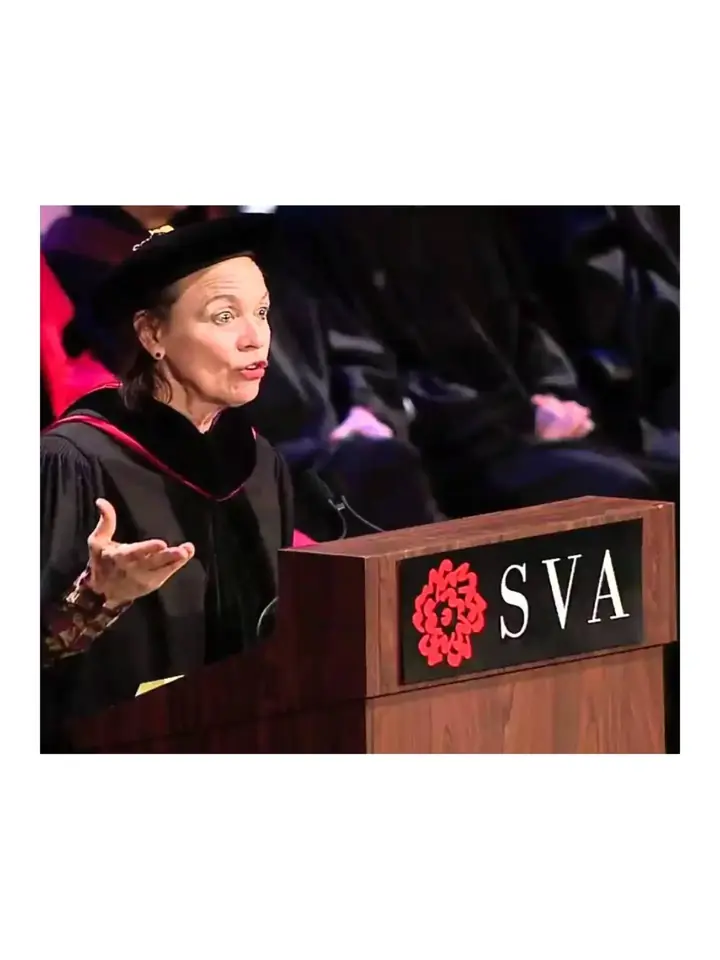
There’s something very useful about putting someone in a room whose job isn’t to optimize anything, produce a report, increase efficiency, or protect the institution’s interests. Someone who can just look around and ask what exactly is going on here, and why everybody seems to think it’s perfectly normal.
Knowing how to build something doesn’t automatically qualify you to decide what the rest of humanity needs, and the humanities shouldn’t have to keep apologizing for being in the room.
Of course I’d like my students to understand how these systems work. But I’d also like them to recognize the room in which they were imagined, the people who were there, the people who weren’t, and how the money moves. Particularly when somebody in that room starts speaking on behalf of all of us.
And maybe ask for the whiteboard marker.